10 facts that will change the way you look after your construction workforce

It’s Mental Health Awareness Week and to help bring the importance of this to your construction workforce, here’s our review of some of the top mental health related research statistics from the last 12 month and the impact on the construction industry. Plus what you can do to protect your construction business.

1. Time to recognise there’s a problem
73% feel that their employers within the construction industry do not recognise early signs of mental health problems. (Source: Ranstand survey 2017)

2. One third affected
34% of the construction workforce have experienced a mental health condition in the last 12 months. (Source: Ranstand survey 2017)

3. Staff turnover and retention exodus?
Just under a quarter of construction workers are considering leaving the industry in the next 12 months. (Source: Ranstand survey 2017)

4. Women suffer more than men
Whilst the construction industry wants more women at all levels 46% of female respondents said they were currently suffering from a mental illness, a higher proportion than men. (Source: Ranstand survey 2017).

5. Literally a matter of life and death
There were 1,419 suicides in the industry from 2011-2015, this was much higher than any other profession. To put that into context, construction workers are 63% more likely to die by suicide than the UK national average. (Source: Government HSE report)

6. Construction staff say they need more help
32 per cent said that the wider industry needed to provide more support for physical and mental wellbeing. (Source: Construction News)

7. Staff keen to use better support
Nearly two-thirds (64 per cent) of industry workers said they would use wellbeing services if their employer provided them. (Source: Construction News)

8. Work-related illness due to mental health problems
According to Health and Safety Executive figures, 18 per cent of reported work-related illnesses in the UK construction industry are the result of mental health problems, such as stress, depression or anxiety. (Source: Government HSE report).

9. The Construction industry accounts for 27% of fatal accidents to employees and 10% of all major injuries which occur each year. (Source: Government HSE report).

10. 400k working days lost each year. (Source: Government HSE report).
That’s why having an employee assistance programme in place is now an essential investment that pays dividend. It’s exactly what your organisation needs in order to offer avoid these problems and give better support to your workforce.

Watch Marc Preston presentation in a live-cast he made on the 15th of May during Mental Health Week HERE on ‘How to support mental health in the work place’. Discover some of the ways his unique service is helping construction companies tackle this immense challenge and at the same time improve the performance of staff and companies as a whole.

For more information on our unique Employee Assistance Programme, or book a Mental Health First Aid Training Course to support your employees, call us now on 0800 634 5521 or visit our CONTACT US page.
UK Construction Week 2017

UK Construction Week 2017 has been and gone, and it’s been a wonderful experience. With special guests such as Kevin McCloud from Grand Designs, BBC Breakfast’s Steph McGovern and even the Dulux dog, the 3-day event was full of surprises. People from all over the country banded together to discuss construction issues, from the latest technology to the LGBTQ+ community.
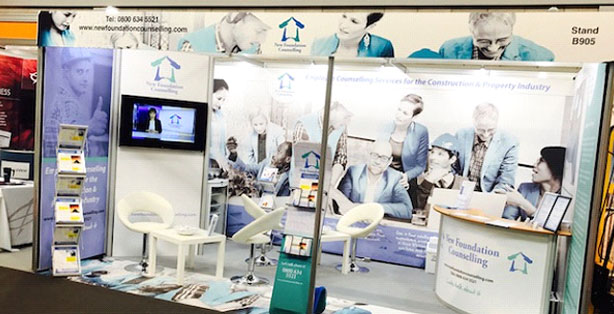
New Foundation Counselling took to stand B905 to talk about a very sensitive issue in construction – mental health. Despite 1 in every 6 people in our industry having mental health problems, we’re still very reluctant to talk about it, which was one of our focus points during our CEO, Marc Preston’s talks at the event.
On day one, Marc spoke in the How To Theatre, discussing ways to recognise the signs of mental health, stress and anxiety in the workplace. The seminar was well attended, and the audience seemed to understand the catastrophic effects poor mental health can have. Poor mental health doesn’t only affect the person with the illness, but also those around them. Someone who suffers from mental health issues could also affect health and safety around the construction site, literally putting lives at risk. This is why it’s so important to look after your employees, and get them the support they need.
Owing to the success of the first talk, Marc was asked to speak twice more on the Thursday; the last day of the event. Again, the talks, both of a similar nature, went especially well and helped to raise awareness of the stigma surrounding mental health.
Marc also announced the launch of the new best practice mental health policy for use in the industry, the certificate of excellence scheme for firms with good mental health systems in place for staff and our affordable Mental Health First Aid Training. Marc said; “the market is being incredibly responsive to our new initiatives to improve mental health in our sector. I am impressed with the excellent culture and attitudes towards mental health issues being expressed by the decision makers in many of the forward-thinking companies visiting our stand. It was interesting to note that the firms taking up good mental health policies were also those performing best over a range of other corporate matters including growth in profitability.”
Creating a brilliant end to a fantastic 3-day event, New Foundation Counselling was awarded the prize for the Best Shell Scheme 2017 at Construction Week. We’re delighted to announce the first of Marc’s talks was recorded, and you can watch the footage here. If you have any questions about New Foundation Counselling or UK Construction Week 2017, please don’t hesitate to get in touch. Call us now on 0800 634 5521 or email us on info@newfoundationcounselling.com to find out how you can support your staff and become a part of the winning team.

Mates In Mind

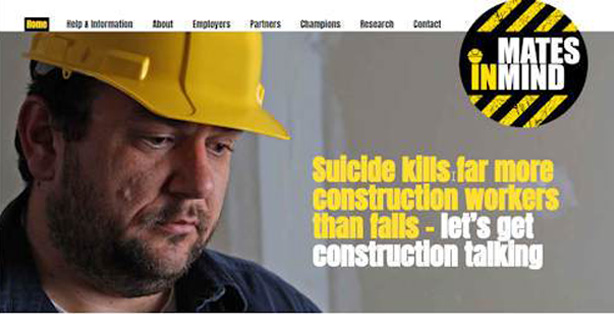
Mates in Mind is a charitable programme designed to improve and promote positive mental health in construction. The “Mates in Mind” programme is an industry wide initiative which was launched by the Health in Construction Leadership Group and supported by the British Safety Council to raise awareness and promote understanding about mental ill health in the construction industry. Their overall aim is to eradicate the ill health and disease caused by work-related activities, and this includes addressing mental health. They estimate that the number of deaths from suicide in the construction industry could be as high as 10 times more than those from fatal accidents at work. An important part of the Mates in Mind strategy is to provide training and information to employers to help them to address the issue of mental health amongst their employees. For more information about how you can get involved in the Mates in Mind programme

Construction News – Mind Matters Campaign

An online survey on the Chartered Institute of Building (CIOB) website showed that 84% of construction professionals polled felt that stress in the construction industry was a factor for poor retention levels. The survey generated 847 participants of whom 578 claimed to have suffered from stress, anxiety or depression. 50.5% of respondents indicated that they had taken time off to help them to cope with occupational stress although only 6% did so formally. CIOB speculate that this reluctance to disclose stress may be due to concern about any negative perceptions or negative impact on their careers if they openly admitted it. The report also talks about the knock-on effect of stress because of its impact on the individual’s performance, and the possible risk to colleagues who may be dependent on the judgement of a colleague experiencing difficulties. Clearly there are implications for the health and safety. To read more about the CIOB report on stress in the construction industry


Occupational Stress In The Construction Industry

Stephen Martin Director General of the Institute of Directors – has launched a mental health campaign to encourage their 30,000 director members to join the campaign to raise awareness of staff with mental health problems at a work. A survey of their directors found that over half had been approached by staff with mental health issues that affected their ability to work effectively. They are launching an online sign posting service for help. For more information about the IOD’s mental health campaign

Institute of Directors Launch Mental Health Campaign Aimed At Employers

Stephen Martin Director General of the Institute of Directors – has launched a mental health campaign to encourage their 30,000 director members to join the campaign to raise awareness of staff with mental health problems at a work. A survey of their directors found that over half had been approached by staff with mental health issues that affected their ability to work effectively. They are launching an online sign posting service for help. For more information about the IOD’s mental health campaign

Time For Change Campaign

Time For Change is led by the charities Mind and Rethink Mental Illness. They are working to encourage employers to take the Employer Pledge and make a commitment to change how we act and think about mental health in the workplace.

Nine in ten people with a mental health problems experience stigma and discrimination. As a result, a key part of this initiative is to encourage employers to take steps to destigmatise mental health illness in the workplace by creating staff Mental Health Champions as well as providing information and resources to help affected employees to get help.

Prince William – Support For Mental Health Counselling for men

Prince William called the high rate of suicide in men “A strain on Society.” He is also a supporter of the Mental Health Charity The Calm Zone and their campaign Against Living Miserably. The Campaign Against Living Miserably (CALM) is an award-winning charity dedicated to preventing male suicide, the single biggest killer of men under the age of 45 in the UK. They report that in 2015, 75% of all UK suicides were male.

Research by the British Association of Counsellors & Psychotherapists revealed that compared to five years ago, 62% had a higher percentage of male clients.

It seems that more men are seeking counselling than in the past because of a gradual shifting of attitudes about gender roles, as well as a growing recognition of the benefits of counselling itself.

Traditionally, men have been socialised to repress their emotional needs as a part of masculinity. This is despite the fact that men have exactly the same emotions as women and feel things such as anger, grief, shame, sadness and anxiety.

Expressing feelings has been stigmatised as weakness for men leading to feelings of shame and isolation which in turn often causes men to bottle up psychological difficulties which risks them becoming more entrenched and severe.

There are many compelling reasons why men should be encouraged to talk through their concerns with a professional counsellor.

Despite the recent increase in the number of men seeking counselling, numbers are still low compared to women. There is also evidence that men are more resistant to seeking counselling than women which is of concern giving the fat that men are at a higher risk of suicide across all age groups, but particularly men under 50.